
Case File · Florida Supreme Court
The Supreme Court Sick Building Mystery
Summer 2004. A persistent chemical odor in renovated sub-basement offices. Follow the investigation from first hypothesis through clearance testing to the final verdict — then put the same forensic IAQ approach to work on your facility.
When
Summer 2004
The Client
The Florida Supreme Court
The location
Sub-basement offices
Facing unexplained odor, irritation, or renovation fallout in your building? HC3 brings the same industrial hygiene rigor used on this Supreme Court case — sampling, moisture diagnostics, and defensible clearance — to facilities across Florida and beyond.
Start a facility investigationCase File: The Supreme Court Sick Building Mystery
Part 1: Operation Odor Phantom
The Scene:
It’s Summer 2004.
The Client: The Florida Supreme Court.
The location: The sub-basement of the Florida Supreme Court building.
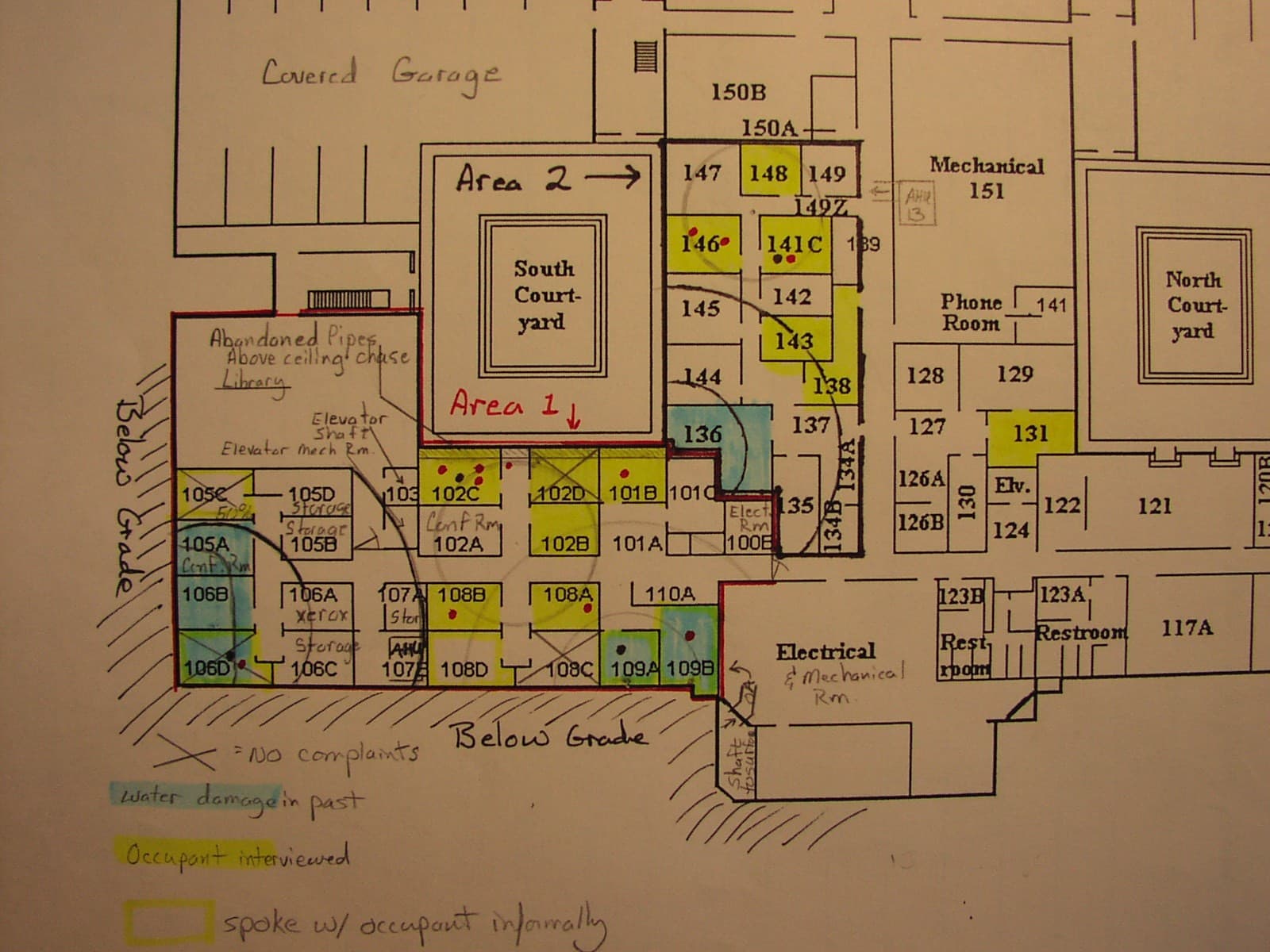
Background Intel: Office occupants, mostly junior and mid-career lawyers, are reporting a persistent chemical odor in their newly renovated offices. Complaints of eye and upper airway irritation are mounting. The facilities team suspects it has something to do with the carpet, but it’s practically brand new, and no signs of current water damage are apparent. More troubling is that the same new carpet was installed throughout the floor, but complaints are only coming from certain areas.
Investigation:
A consulting industrial hygienist is brought in to investigate the cause and solve the problem.
Initial hypothesis: Microbial and moisture damage somewhere in the sub-basement. Odor complaints and irritation predominate,
Missing Connection: No “musty” odor complaints, the relative humidity is good, and ventilation rates to dilute typical indoor VOCs are meeting the ASHRAE Standard. No staining of carpet, drywall, or ceiling tiles from water intrusion is visible.
The Investigator suspects that VOCs emitted from the vinyl carpet backing are degrading, reacting with moisture in the slab to release specific “marker” Volatile Organic Compounds (VOCs).
Unknown Link: Why would this only be occurring in some offices where new carpet was installed and not all of them?
The Investigator maps out the offices where complaints are occurring and where past water damage was reported and then reviews the scope of work and requirements for renovating the sub-basement so that offices could be constructed. Some clues come to the top.
1.Confirmed the carpet was vinyl-backed
2.Learned that leveling compounds were needed to smooth “raked” concrete slab in some areas of the sub-basement
3.A new ventilation system and externally insulated ducts were installed for the offices
Testing for VOCs that may be causing the odors and irritation may be helpful. Samples from complaint areas and non-complaint areas on the same floor and in upper floors of the building. Results found a group of marker VOCs that were much higher in complaint offices than in non-complaint offices.
Indication: These indicators VOCs, had been found to be emitted from degrading vinyl-backed carpet in earlier published studies. It was the carpet…but where is the moisture coming from?
The remediation plan was aggressive. We aren’t just pulling carpet; we are abating everything under containment—carpet, adhesive, and vinyl cove molding.
Engineering Controls: Negative pressure containment, exhausted to the outdoors that was constantly monitored.
The Target VOCs: 1-Hexanol, 2-ethyl and related isomers, are related to degrading vinyl-backed carpet products.
By July 7, the abatement was done. The carpet was gone. But in the world of IAQ, removal is only half the battle. Was the odor gone? Under containment and enhanced ventilation, the odor may be just diluted. Once placed back into “normal operation,” would the irritating odor reappear? We needed to prove it worked.
The Dilemma:
We are doing clearance testing. We have the “marker” compound baselines.
QUESTION FOR THE PROS: Before we move to clearance testing, what is the risk of failure during a project like this? Why could residual odors persist: leftover adhesive, dust, adsorption of VOCs to wallboard and ceiling tiles, or re-emission of VOCs from the concrete slab? Drop your pre-clearance checklist in the comments. 👇
The Verdict
What actually caused it
The water wasn’t coming from the ground. It wasn’t a pipe leak or secret underground stream.
The “leveling compound overlay” applied during the recent renovation never finished curing before the vinyl-backed carpet was installed. In the humid Florida climate, the overlay moisture was trapped when the impermeable vinyl-backed carpet was installed over it. This created a chemical reactor, containing water, high pH from the concrete, carpet adhesive and vinyl-backing resulting in a VOC cocktail that emitted irritating VOCs that had an offending odor.
We advised the client against sealing the slab with some other chemical. Sealing might not work and could just trap moisture again, creating another “chemistry experiment”. The prescription? Time. The overlay needed to breathe and finish the cure that started years ago. Increasing the ventilation rate of the space, raising the temperature and lowering the relative humidity would hasten the process, but diffusion take time.
Sometimes the “contaminant” isn’t an external invader; it’s a construction material that never got the chance to dry.
Sound off: Have you ever seen a “Green Slab” failure disguised as a plumbing leak? Share your stories below. 🏗️⚠️
When odor complaints look like water intrusion — but the data points somewhere else — you need an investigator who will keep asking until the chemistry adds up.
Talk to HC3 about your buildingTechnical findings
Conclusions
Full conclusions from the live case file — select a card to read each finding.
Case figure
Indicator VOC trends referenced in the conclusions
This chart belongs with the technical findings — not the hero. Tap to enlarge.
View case photo gallery →Images
Case images
Field and lab evidence from the investigation — the same photo gallery from the live site. Click any photo to enlarge.
Download your copy
Case file PDFs
The Supreme Court Sick Building Mystery — Parts 1–3, hosted on HC3FL.
Get Your FREE ODOR NUISANCE FLOW CHART
By subscribing to our newsletter — the same offer from the live Sick Building Mystery page.
Webinars & workshops
Need help applying this to your facility?
HC3 consultants support Legionella programs, indoor air quality investigations, and industrial hygiene assessments across Florida and beyond.
Request a Consultation